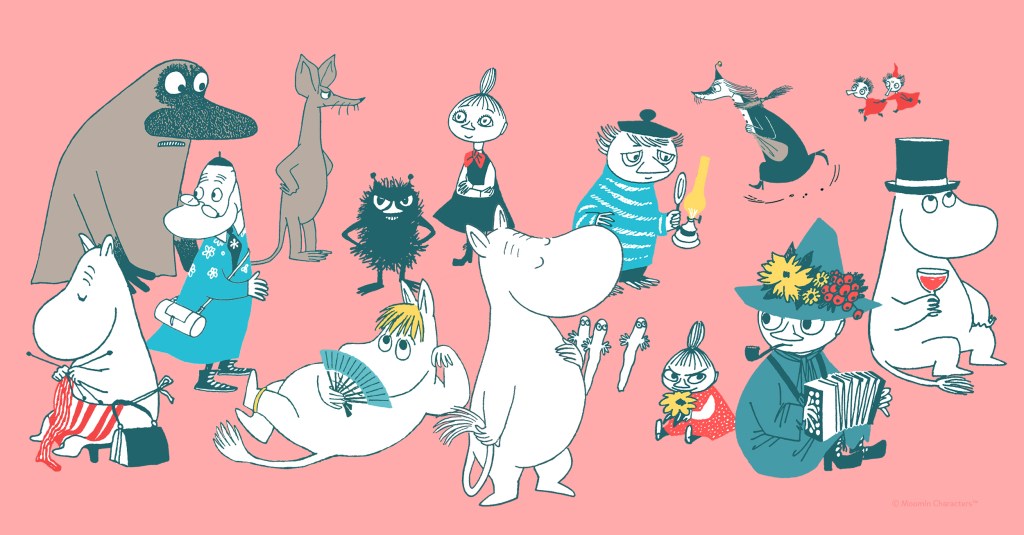
I love Moomin trolls. If you’re unfamiliar with them, Moomin trolls are hippo-like creatures that star in a beloved series of books and comic strips created by Swedish-Finnish illustrator Tove Jansson. The Moomins originally appeared in 13 illustrated books written in Swedish from 1945 to 1977 and have since been translated into over 50 languages. In Finland, Moomin is more than just a series—it’s a cultural phenomenon. These little white trolls can be found anywhere! And whenever I meet anyone from Finland, there is an instant bonding over Moomin. The Moomins have been adapted into animated TV shows and can be found in museums, theme parks, cruise ships, and various consumer products. Their popularity has even led to them being featured on Finnair airplanes. Growing up with a Finnish mother, I was introduced to Moomin at a young age and our home was always filled with Moomin ceramic bowls and mugs, and their simple, cute illustrations sparked a child-like joy in me.
Whenever I visit Finland now, I can’t resist picking up another Moomin-themed mug, plate, or little trinket to add to my growing collection. These collectibles help me maintain a strong connection to my Finnish roots, and come on, they are just so darn cute.

But it is true, the Moomins are very much entwined with Finnish culture and since their creation have become a quintessential part of it. The stories and drawings are inspired by many aspects of Finland such as nature, its cultural traditions, and ideals. Many of the stories encapsulate subjects that are very Finnish, such as harsh winters and a love for nature, and the Moomin trolls themselves are often found camping, exploring the archipelago, and going into the woods. Tove Jansson spent many of her summers in the Stockholm archipelago and Pellinki, out in the archipelago of the Gulf of Finland, shaping her love for the Scandinavian islands. In 1960, Tove with her partner Tuulikki Pietilä built a small summer house on an island in the Finnish archipelago where they spent over 30 summers together. Her love for the islands, the forests, and the landscapes of Finland, and the freedom they provided ultimately inspired her drawings for Moomin Valley with vast lakes and big green forests.
Many of the morals and values Tove Jansson highlights have to do with acceptance, inclusion, and community, and although it may seem like just a children’s cartoon I am certain that even adults can gain a life lesson from the stories here and there.
Tove Jannson was a remarkable lady and one of the best Finnish artists of all time (she is the most widely read Finnish author abroad!) She was born in 1914 to parents who were both artists: Finnish-Swedish Viktor Jansson and Swedish Signe Hammartsen-Jannson. Her father was a sculptor who was mainly inspired by the female figure, and his most well-known sculpture, Convolvulus (1931), can still be found in Kaisaniemi Park, Helsinki, Finland. And guess who the model was for this sculpture! No other than his daughter Tove. Her mother, Signe, was an illustrator and artist who, among other projects, designed the banknotes for the Bank of Finland and also worked on the design of the Finnish post stamps.

Thus, it comes as no surprise that Tove decided to pursue a life of artistry as well. Her two brothers, Olov and Lars, did the same. Olov set out to become a photographer, and Lars a writer.
What Tove Jansson created with the Moomin trolls is truly remarkable, establishing them as a beloved symbol of Finland and a cultural token. In addition to the Moomin books and comics, Tove gained recognition for her short stories and novels, making her ability to write for both children and adults quite evident.
And Tove herself was a remarkable lady with a life fully lived. I recently read the biography “Tove Jansson: Work and Love” by Tuula Karjalainen and it was amazing. I was just stunned by her life. The way it was written can also not be overlooked. It was well organized, and it was written in a way that kept you engaged. It was an overall very enjoyable read so if you ever get the chance read it!

When I asked my mother what her thoughts were on the Moomin trolls she said this:
When she was younger there was a box with children’s comics in the school library in Sweden. And of course, there were also Moomin comic books. This is where she was first introduced to this world of wonderous little characters. She told me that she was fascinated by them. “All the human emotions are represented by the characters,” she said which she may have not realized at the time but ultimately made her gain a greater acceptance of all the emotions she felt. They are just human and okay after all, “there is no emotion that is wrong”. Reading the comics you learn to accept even the monsters in the stories, which translates to an acceptance of others in the real world as well. No matter how different one may be.

So there you have it, the Moomins are much more than the quirky little white trolls that are made into souvenirs. They are the charming little characters that were able to become deeply rooted in a country’s culture reflecting its landscapes, traditions, and values, while also teaching timeless lessons about acceptance, community, and self-expression, all through the creativity of an astoundingly talented woman, Tove Jansson. Through Tove Jansson’s extraordinary talent, the Moomins have become a global phenomenon, bringing joy and inspiration to people of all ages. Whether through their whimsical adventures or their profound messages, these little trolls continue to hold a special place in hearts worldwide—and in mine.
If you want to explore the Moomin world further:
Check out the Moomin Website here
– Nina ♡


 The Cozy Tulip
Leave a comment